
Hospital Food
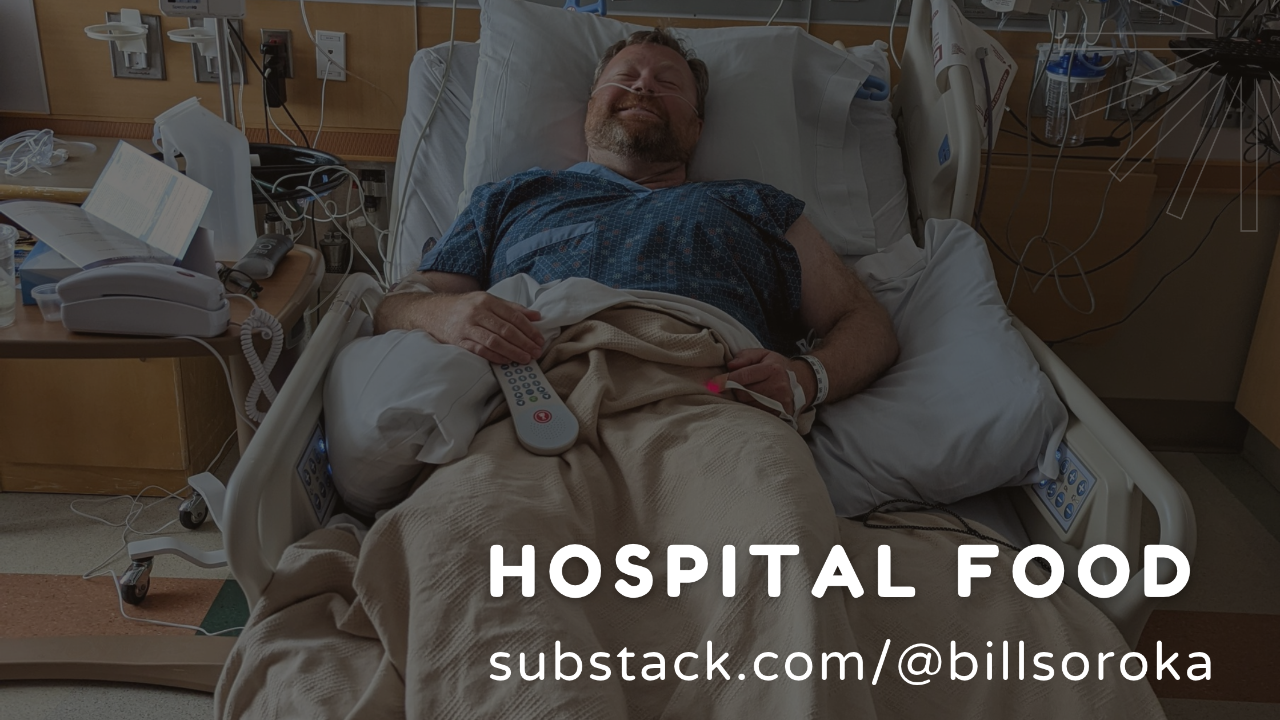
Oct 24, 2026I spent a week in an ICU after nearly dying from a double-saddle pulmonary embolism in 2022.
Being that close to death can be scary, but trauma aside, that 7-night all-inclusive stay in Skagit General’s Intensive Care Unit was, despite its expense, one of the most relaxing vacations I’ve ever had.
I want to be sensitive to other people’s ICU experiences, so please don’t take this the wrong way, but as a high performing entrepreneur who had been bootstrappin’, hustlin’, buildin’, runnin’, survivin’, for 45 years, that little week-long break was a welcome respite.
Before this, even vacations included some level of work. I’d be in mountain towns, exploring the terrain, and break early to hop on for a webinar. Or, I’d record a video from the beach in Hawaii. Or, finish course modules from Yosemite.
Pleasure trips were always blended with work. It was the trappings of both a career I loved, and the deep-seeded belief that recreation had to be earned, and I was not yet worthy.
But for that week, post-PE, I did nothing.
I had my laptops (plural) delivered to my “suite,” just in case.Never opened ‘em. Didn’t even have the desire to.
At the time, I was in the middle of final edits for one of my books. Didn’t matter, didn’t care.
I was strangely at peace, with a genuine reverence for what I had just experienced. I had been minutes from death, and I knew I had to heal, and resting was the most productive thing I could do.
So I did just that. I vegged out, guilt-free, laying in an adjustable bed, watching true crime shows, sleeping intermittently, and eating.
Eating surprisingly well, by the way.
Maybe it was the drugs, because, damn, those were good too. But the daily food options in that hospital could have been found on any popular restaurant’s menu.
Chicken cordon bleu.
Cheeseburger.
Spaghetti.
Rice bowl.
And salads, of course, but I always skim right over those. I’ll never forgive myself if my last meal is a salad. And it seems to me, that in a hospital, an ICU no less, those odds are exponentially higher. So, no salads.
And you order your meals, just like room service. I guess I just never spent much time in hospitals before this, so I assumed you just ate whatever they cooked, like in prison. I don’t know this from experience, yet, but I assume that’s how prison meals work. But if not, I might have another essay coming soon. Standby.
But at the hospital, I just picked up the phone, ordered what I wanted, and thirty minutes later it was delivered to my bed. Heaven, right?
Luxury hotels have nothing on ICUs. Listen, after I ordered, I didn’t have to “clean” my room and make space for the incoming tray. I didn’t have to hide the scattered clothes and midnight candy wrappers.
I didn’t have to throw on a robe to answer the door. I didn’t even have to get out of bed!
She just rolled the table in front of me, across my lap. So, there I was, in all my glory, nothing but a tacky, thin, purple gown between me and my room service attendant. She practically tucked me in for my meal. And, honestly, had I asked her, I think she would have spoon-fed it to me.
But I didn’t want to get too bougie. I suppose I could feed myself, just this once.
Then she left me to it. No tipping. No awkward exits. Just peace-out, she was gone.
When I was done eating, I simply pushed my tray away. Just pushed it away! Someone else took care of it. I didn’t even have to place the empty tray of dishes in the hallway. Which is such a relief because I still don’t know if that’s the socially acceptable thing to do in hotels or not. Is that rude? Is that expected? I don’t know where that chapter is in life’s manual.
Sure, this may have been the most expensive vacation I’ve ever taken, but it was worth every penny.
Which means, my Grandma Marjorie was right...again.
Years earlier, when she was well into her retirement after being a nurse for 20 years, she was gardening and recognized the symptoms of an oncoming stroke. Her experience as a nurse, and also as a widow of a man who had many strokes, one of which ultimately killed him, made her more sensitive to these symptoms than most people.
But, where most reasonable people might have called for help from a neighbor, or for an ambulance, “Marge” decided to get behind the wheel of her Town Car, and drove herself to the emergency room.
We Sorokas are a resilient bunch, but not always “reasonable.’ No, that’s a different “r” word. Right next to “stubborn” in the dictionary.
But here’s where our resilience comes in...
That unreasonableness (is that a word?), likely saved her life. At the very least, it mitigated the damage from the stroke, which made her recovery a matter of weeks, instead of months, or even years.
So, she got a week-long stay in St. Joseph’s, and when I’d call or visit every day to check on her, the first thing she raved about was the food. I assumed it was the stroke talking. Remember, I thought hospital food was the same as prison.
But no, she went on and on about how it was like room service in Laughlin, Nevada. And the food was delicious, she would emphasize, as only she could do.
And the salads, she insisted, were the best she’s ever had. Clearly, the stroke talking.
But her favorite were the desserts.
She must have eaten her weight in tapioca pudding.
Pudding.
Whatever happened to pudding?
Maybe hospitals get a bulk discount on the stuff, because I did the same thing during my hospi-cation.
I’d very nearly forgotten pudding even existed until it showed up on my tray every day.
Isn’t that funny? As a kid, I remember eating pudding every day, packed in a lunch made with love, and yep, tapioca was my favorite, but then...what?
What happens to pudding when you turn 18?
It just seems to vanish.
Until you end up in a hospital, where it reappears again, still packed and served with love.
Do you like to write?
Never Miss a Writing!
Join my mailing list to receive the latest writings and updates.
I will never sell your information, for any reason.
